Yep, George, that’s what I’m thinking as well. Placing a Mic in the middle of the room (=in front of the PA) you’re likely to be able creating feedback at any frequency, depending on the distance between the PA and the mic (you’re not adressing room resonances with such a setup at all!). If you’re driving left and right PA from that mic, observed feedback frequencies are pretty much random and will vary with slightly moving the mic (phase effects from left and right side of PA).
You may place a measurement mic (connected to a RTA) somewhere in the room, preferably a boundary layer mic if there are reflecting walls to measure your room. But you may also encounter a venue with highly reflecting walls on every side, no chance to EQ the room that way at all, since there were peaks and notches at different frequencies everywhere.
A rectangular room should have fundamental resonances at two frequencies only (left-right and front-rear) and maybe the first harmonic.
The louder you try to run your PA, the more problems you’ll get. And when the room is filled with audience, things will change as well.
So I repeat what already was said a lot: With IEMs you really should not have serious issues with feedback from vocal mics, except you’re a) running too loud or/and b) allow your mics to catch audio from the PA (either direct or by reflection).
CK…
Ringing out the room with the method I sent you deals only with room resonances/standing waves…as clearly stated in the PDF. Also mentioned in the PDF and in this thread is the fact that such resonances are generally found below 300hz.
When you encounter massive amounts of feedback all coming on at the same time this just means that you have reached the limit of GBF in the room. There is nothing you can do with EQ or anything else at that point regarding remedies. Here’s the list of salient features once again:
-
Speakers with pattern control going as low as possible. Factors in play here are cost, size and weight.
-
Proper processing of the speakers with DSP. Best bet would be manufacturers settings in either a proprietary black (or is it gray, I forget) box or loaded into an outboard DSP compatible with the processing required.
-
Proper placement of the speakers in the room with regard to focus on the audience area and avoidance of spill onto reflective surfaces such as walls and ceiling.
I notice in some of the videos on your website that the speakers are on either side of the stage and what looks to be at least 6 feet behind the front line mics. The simplest way to improve your GBF/headroom is to get those speakers ahead of the mic line. If you can’t do that, you’ll have to accept diminished usable gain and very touchy issues with feedback.
You can’t have everything. Choose your poison.
DR, wishing you good luck in your quest.
Hi
The “Centre room” mic (Only one of the many ways I attempted to sort this issue yesterday) was suggested by Dick Rees in his PDF.
1. Speakers with pattern control going as low as possible. Factors in play here are cost, size and weight.Please feel free to explain this further. I own 2 X Yamaha MXR400 & 1 x Yamaha MXR800W with a total output of 1.6kw.
2. Proper processing of the speakers with DSP. Best bet would be manufacturers settings in either a proprietary black (or is it gray, I forget) box or loaded into an outboard DSP compatible with the processing required.Again, please feel free to elaborate on what you mean here in laymans terms.
3. Proper placement of the speakers in the room with regard to focus on the audience area and avoidance of spill onto reflective surfaces such as walls and ceiling.Speakers are always placed properly pointing into where the crowd will be and not angled towards walls (Although I do not have down angled mic stands, but am thinking of investing in some).
I notice in some of the videos on your website that the speakers are on either side of the stageWhere else do you suggest I put the speakers? Guests need to be able to see the band.
and what looks to be at least 6 feet behind the front line mics. The simplest way to improve your GBF/headroom is to get those speakers ahead of the mic line. If you can’t do that, you’ll have to accept diminished usable gain and very touchy issues with feedback.
I would NEVER put the speakers behind the mics in a live scenario, so I dont know what video you are talking about here?
Unless you mean our “Playing to backing track mimed promo video”?. This isnt live so the speakers have been arranged for aesthetics only.
I thought I was getting somewhere as I’d EQd out the worst frequencies with the first on stage vocal mic (AKG D5) with it sounding great AND loud, but then the second I turned on the second stage vocal mic (Sontronics STC-80) there were more frequency issues through this one.
So how is this “Tuning the room” it seems more to me like “Tuning each mic for feedback”?
As you say though I had probably had just reached maximum gain before feedback in the room.
Dick - Its worth pointing out that in your PDF you state
“Step 2. Set up your mic in the very middle of the room, point it straight up and raise it to 7 or 8 feet in the air. If this puts it within 3 feet of the ceiling, you’re in the wrong room”
I’m not sure if this PDF is aimed at HUGE venues, massive halls etc, but we dont all have the priveledge of being able to turn down work if the venue is on the small side.
Cheers
11 foot ceiling - luxury…
CK…
The ceiling comment was a bit of humor, but there’s a kernel of truth there. If your room is 2000 sq ft with a ceiling lower than ten feet there are more problems to deal with. Our home (built in 1921) has 9.5’ ceilings. I’m not really comfortable with the “new standard” 8’ ceilings.
In your “load-in” video I see you’ve got your speakers set up on the stage. This in itself is neither wrong no right, but it looks like there was some kind of truss or other dropped support structure running across the stage front. This, combined with the sloped ceiling, might well give you a few problems you wouldn’t have if you set up your speakers on the floor “outside the box”.
You’ve got a great, rockin’ little band. Looks like you have a lot of fun.
Gotta go now. More later.
DR
Please feel free to explain this further. I own 2 X Yamaha MXR400 & 1 x Yamaha MXR800W with a total output of 1.6kw.
CK… There’s your problem (assuming you mean MSR and not MXR which seems to be a trail bike?)
From the Yamaha website…The MSR400 employs a two-way bi-amplified system in which the low-frequency and high-frequency drivers have their own dedicated amplifiers. The 12-inch cone type woofer and the 1.75-inch high-frequency horn driver deliver total output power of up to 400 watts (LF: 300 watts, HF: 100 watts burst; 300 watts continuous total).
If this is a rock band, then you need more ‘rig for the gig’ and having that extra headroom will help with the feedback issues. If you can afford for the band to all be on in-ears, why scrimp on the PA?
Thanks everyone for the audio links and insights. I’m not a pro audio engineer and have a lot of learning to do. I have been doing sound primairly for a seven piece Traditional Irish band for about five years now. We usually play events where we only need to be 2-3 times louder than we would be without any reinforcement, so this is good information for when we need umph. I just acquired a Qu-Pac and appreciate the helpful operational insights there too. Thanks.
Please feel free to explain this further. I own 2 X Yamaha MXR400 & 1 x Yamaha MXR800W with a total output of 1.6kw.
CK… There’s your problem (assuming you mean MSR and not MXR which seems to be a trail bike?)
Apologies, this should have read MSR not MXR
From the Yamaha website…The MSR400 employs a two-way bi-amplified system in which the low-frequency and high-frequency drivers have their own dedicated amplifiers. The 12-inch cone type woofer and the 1.75-inch high-frequency horn driver deliver total output power of up to 400 watts (LF: 300 watts, HF: 100 watts burst; 300 watts continuous total). If this is a rock band, then you need more ‘rig for the gig’ and having that extra headroom will help with the feedback issues. If you can afford for the band to all be on in-ears, why scrimp on the PA?
Its worth noting that I have only ever run this system at FULL VOLUME once since I have owned it
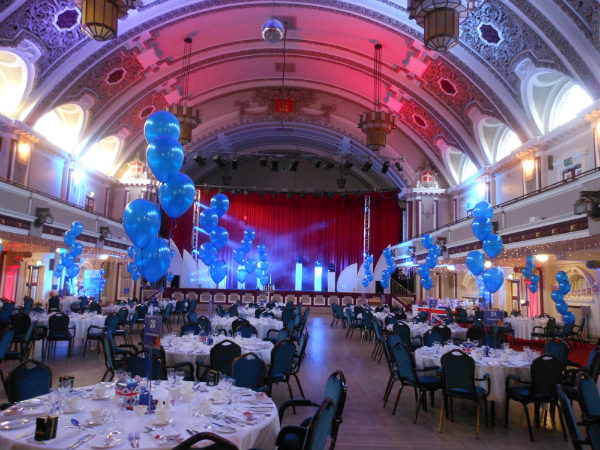
Stoke Town Hall - https://www.conferencestaffordshire.co.uk/media/1300/city-of-stoke-kings-hall-function-cabaret-style.jpg
We actually had to link up a second PA system too that was also running at full (The client did not inform us of the enormity of the venue nor of the event type otherwise I would have demanded they got a company in to do the sound, luckily we pulled it off…just about).
We are a pretty quiet band, playing to the volume of the drummer (He’s not a basher and is a pro drummer) and I never have to usually take the volume of the rig past half way (12 o’clock settings on the rear of the top speakers), so the “Extra headroom” is not an issue for us as we always have extra headroom.
I do not feel I am scrimping on a PA system for the types of venues we play which are usually wedding venues with the main room being smaller than 10m x 15m with no more than 150 guests. It was about £1500 when I purchased it.
The “volume” setting on the back of the speaker, is actually an attenuator. Think of it as the control you use to set how loud the input signal needs to be before the amp starts clipping. I’m not going to start doing maths, but the 12 o’clock position appears to be +4dB. Your Qu is capable of putting our lots more than that (maximum output is given as +22dB), so you could in fact, easily be clipping the PA or running at full volume.
My regular PA is more than twice the power of yours and probably a more efficient design*. I’ve occasionally struggled for volume in venues smaller than the wedding venue you describe with it.
Sorry - not what you wanted to hear, I know.
*Power alone doesn’t really give any indication of how loud a speaker is - efficiency is much more important. How it sounds is quite important too!
Hi Mark
Sure, like I say though I never really ever have to have the top speakers running at anything louder than 12 o’clock/+4db as its loud enough for most venues we play with those settings rear.
OK - Just reading numbers from specs is not exactly like real life, but it does tend to give some clues!
The desk has “Nominal Output” “+4dBu = 0dB meter reading” (page 82)
So even the first yellow on the meter is hitting the max for your speakers if you set them at +4. Turn the attenuator on the speakers up (clockwise), and you’ll just hit that same maximum with the desk on a lower level.
At that gig when you turned it all the way up - does that say -36dB on your speaker? - you were hitting maximum even before the second green LED on your meter came on. But it’s still the same maximum whichever way you get to it.
Once you hit that maximum, the limiter in your speaker starts doing things to the sound, which makes it more probable that it will feed back.
I use msr400s quite often, and tend to have the volume dial at about 9 o’clock (else I hit clipping before the meter moves appreciably)
But… they aren’t 400W RMS, look at the electrical plate - max electrical input is 130W, they just can’t push 400W for any length of time.
Personally I prefer the Mackie 450s when I have them available, but the MSR are in stock, so they get the brunt of the work. I’ve run the MsRs with a studio spares (stop sniggering at the back) sub (600W) borrowed from a local theatre when I needed to run e-drums and the full power from the Bass through them, and that worked well. Normally the Bass amp provides 80% of the volume, I just top it up from the FOH 
OK, I’ll put it another way…
If you spent more on the mixer than the PA, then you didn’t spend enough on the PA
If you spent more on the mixer than the PA, then you didn’t spend enough on the PA
I didnt spend more on the mixer than the PA.
That might be a bit harsh nowadays - when the mixer does so much more than mixers of old.
With my RacPac Id have agreed, but with the digital mixers… I can’t think what I’d spent £1600 (£2k if you include a tablet as well) on in terms of PA for smallish venues.
I don’t often do gigs at football stadiums, and when I do I know a man who can provide me with 6-12kW of PA - but that takes a transit van to deliver, the MSRs fit in the boot, along with the desk and various other sundries…
I find the Mackie SRM 450’s fantastic value for what they can achieve, when I do a medium sized PA job I will install up 6 SRM’s and 6 SWA 1501 bass bins, even with just 2 boxes a side I have never hit the limiter’s in them. All my Mackie gear is the original Mk1 Italian/US RCF gear. Harder to get replacement drivers for them these days so I just search the globe picking up bits where I can.
For monitors I run up to 8 Wharfedale EVP 12 & 15PM wedges, again, take a barrage of abuse but deliver when needed.
I think your idea of medium and mine differ 
I find the Mackie SRM 450’s fantastic value for what they can achieve, when I do a medium sized PA job I will install up 6 SRM’s and 6 SWA 1501 bass bins, even with just 2 boxes a side I have never hit the limiter’s in them
These are 90 degree pattern speakers. If you deploy them PROPERLY, you will splay them so that the patterns do not overlap and cause significant degradation of and uneven response in the sound. The ONLY reason to use two/side would be if you need 180 degree coverage. Doubling them up will “look cool”, but the minimal output increase of 3dB will not really be audible and the interference/comb filtering will render channel EQ adjustments much less effective, sounding different at individual listener positions across the sound field.
Using 90 speakers doubled up for less than 180 degree coverage is just plain bad policy if you care about sound quality. If you just need “the look”, put up 2, turn on 1. If you need louder, you MUST buy/rent/use higher output boxes or horn loaded boxes with enough pattern control to be arrayable.
Sorry, that’s just the way it is…
Here’s a graphic representation of what happens when you use two sound sources lacking effective pattern control to cover the same area. Some frequencies cancel at various distances, some reinforce. Result?
Inconsistent sound/response across the listening area…for NO useful increase in output.
It’s physics.

Although can be minimised by design. Tannoy VX8 have a 90 degree dispersion, but are designed to be paired - no idea what voodoo they did, but it works (at one angle, cunningly encoded into the cabinet)