I presently have a Qu32 and am thinking of replacing it with an SQ6.
My question is about stereo Mix monitors.
I am currently using 3 mono and 7 stereo mixes (Groups have been converted to Mix) with the Qu32. Three of these stereo Mixes (5/6,7/8,9/10) go to the stage to a stage box but Mix 1 and 2 and the four converted (Group) Mixes come out of the physical sockets on the back of the board.
The SQ6 is stated to have 12 stereo mixes but the back of the board only shows 14 sockets.
Am I going to be able to configure these physical sockets to accommodate my current needs?
I will need 4 mono plus 3 stereo mixes plus L/R to the stagebox plus 2 mono plus 4 stereo out of the physical sockets on the back of the SQ.
Yes, you can.
The Reference Guide explains it briefly:
“I/O patching allows … any output socket to be fed from any … mix … output.”
And “any” also refers to the outputs of your stagebox.
Confusingly, your local output sockets 11 and 12 are labeled L and R.
Forget about that immediately, because you are free to patch also there, for example, your mono Aux3 and your Direct Output of your channel 15, if it makes sense for you.
1 Like
Absolutely. A mix on the board is virtual, there’s no “one to one” like in the analog world. You can patch your mixes anywhere you want.
The only thing to consider is whether you’re planning to have enough outputs in general. So local plus any stageboxes you might be connecting.
Also I wouldn’t call the last 4 mixes “converted groups”, but that’s an unnecessary nitpicking.
you must distinguish between physical sockets and logicl I/O of the Mixing Engie on the SQ.
on the Engine you have the Direct Outs (up to 48 Mono, up to 24 Stereo or any combination resulting in a maximum of 48 single Signals) of the Channel Inputs, the Main Mix, 12 configurable Mixes (Aux or Group), 3 Stereo or 6 Mono Matrix Mixes and the Outputs of the FX Engines. Mixes can be configured Mono or Stereo. Any of those Outputs can be routed to any Output Sockets (Stereo maybe to socket pairs) on the local Desk, Stageboxes, the 32x32 USB Interface, the integrated Multitrack feature (32 Channels to mass storage on USB-A or any extension Card (DANTE, AES50, whatever else is available). In Addition the Tie Line Feature allows to route any input socket to any output socket bypassing the mixing engine. It is also possible to route output signals to several output sockets the same time. And you can switch the complete routing when loading a scene so the only real limit are the actually simultaneously used signals and the physical socket limits (which are very large with dante or similar extensions).
So the physical ports on the desk are only s subset for local usage on the mixer place (for example the FoH workplace), in a bigger stage or studio setup most I/Os are more handy on stage boxes. of course, you can have a stage box near your mixer if you just need more massive local I/O ports, but in a setup with more than a hand full of signal sources most likely you won’t want to have the mixer desk occupying space between the musicians on stage or recording rooms and you also won’t want long cables for single signals.
From this view, SQ a is much more mighty System option than Qu. If you really need even more I/O,you should really consider dLive or Avantis. But then you need it really big, even smaller live festivals oder not too large musical productions can absolutely be handled using a SQ System very well if you just know what you are doing.
Since the SQ Engine is always the same you can really consider i you want SQ5, SQ6 or SQ7, at the end this is only a question of surface controls, local I/O Options, extension card slots, space and weight. And keep in mind that you have nice remote options using up to three tablets with Sq Control and SQ Mixpad, up to 8 with SQ4you, some alternative more generic Apps and you also can control most mixer functions via USB-MIDI from your DAW.
1 Like
With the addition of stage boxes, you could actually have 14(local)+12( AR2412)+8(AB168) for a total of 34 outs.
Even more than that. According to the A&H I/O Documentation, you can daisy chain one AR2412 and two AB168 to a single SLINK Connection which would give you 28 Outputs on that stage Boxes additional to the 14 on the desk. There is also an Option to use a “DX Hub” to extend SLINK Connections to 128x128 Channels. You can also insert a SLINK Card or a DANTE Card into the Extension Slot and attach even more stage Boxes to that (DANTE should be able to do at least 64x64)
Of course, the SQ System has its limits but the possible Number of I/Os ist not really relevant for almost any use case. If you really get at a limit, it might rather be the 32x32 USB Interface (when multitracking) or the Limits of the processing engine (48 Inputs, 12 Mixes, Main Mix, 3/6 Matrix Mixes). Not really I/O Ports.
There are also the two comparable TRS output jacks A + B, which you can also patch as needed.
Of course, this is just one example.
With different combinations of other stage boxes, many more XLR physical output sockets would be possible if needed.
1 Like
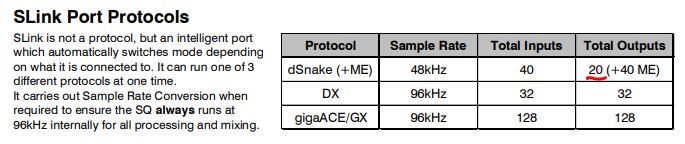
This combination unfortunately doesn’t seem to be possible.
The dSnake protocol allows a maximum of 20 outputs.
Thank you
Interesting, can you link them to get stereo.
But you yourself wrote at the beginning: “SQ Mixes 12 stereo available” - what do you want to link?
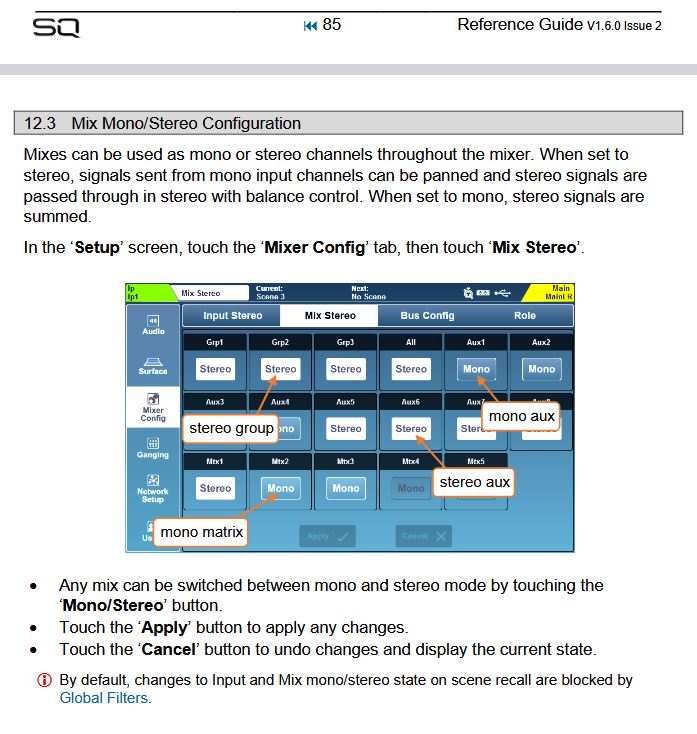
Besides Main LR, you have (up to) 12 stereo mixes available, which you can switch to mono as needed.
This is well described in the Reference Guide (see image), and you have another fantastic option:
Install the SQ MixPad (ideally also on a PC/Mac).
There you can simulate and pre-configure most things, just like you would later on the console.
Ah, if you perhaps meant the (TRS) output jacks …
These are always separate mono outputs.
Just as a side node here… it also seems to be possible to use the 40 ME Monitor ports on a DSnake connection as separate outputs from the SQ if the receiving port is an SLink port. However, this is not officially supported and there is no guarantee for it to work. See SQ to AHM via AR2412 Monitor Port - #5 by docdocdocdoc
So, you’ve got 20 Outputs via DSnake, + 40 other Outputs via DSnake officially not supported, + 14 XLR sockets local on the console + 2 jack outputs local on the console.
As others have stated, the routing in the SQ mix engine is completely free and up to you. Of course, a decent default would be to route it 1:1 from the console’s mixing buses in order to avoid confusion.
Just to add, so no one thinks this would be the maximum:
This is also just an example (based on dSnake), because with up to two SLinks, and in possible combinations with GX or DX stageboxes and DX hubs, many more physical outputs could be provided - even officially supported. )
those 12 Mixes mean i can only have for example 8 Aux-Sends and 4 Groups?
On my AH GL2800 i have 10 Aux Sends + 4 (Stereo)-Groups + 4 Matrixmixes
Yes, but all 12 mixes can be Stereo.
If you need a higher number of Mixes/Buses, you might want to take a look at Avantis.
thanks.. i can look at Avantis … but not pay for it 